 HealthTech · Platform takeover and support
CareMatch: a live UK home care platform taken over from another supplier → no interruption, correct billing and version 2 under way

Tim Chalklen, Chief Technology Officer, CareMatch Ltd
- Industry
- HealthTech
- Challenge
- Vendor can't keep up
- Service
- Product team · Platform rebuild
- Team
- A small part-time team on a fixed monthly budget
- Stack
- Java · React · Google Cloud
- Timeline
- May 2025 to present
- Region
- United Kingdom
About CareMatch
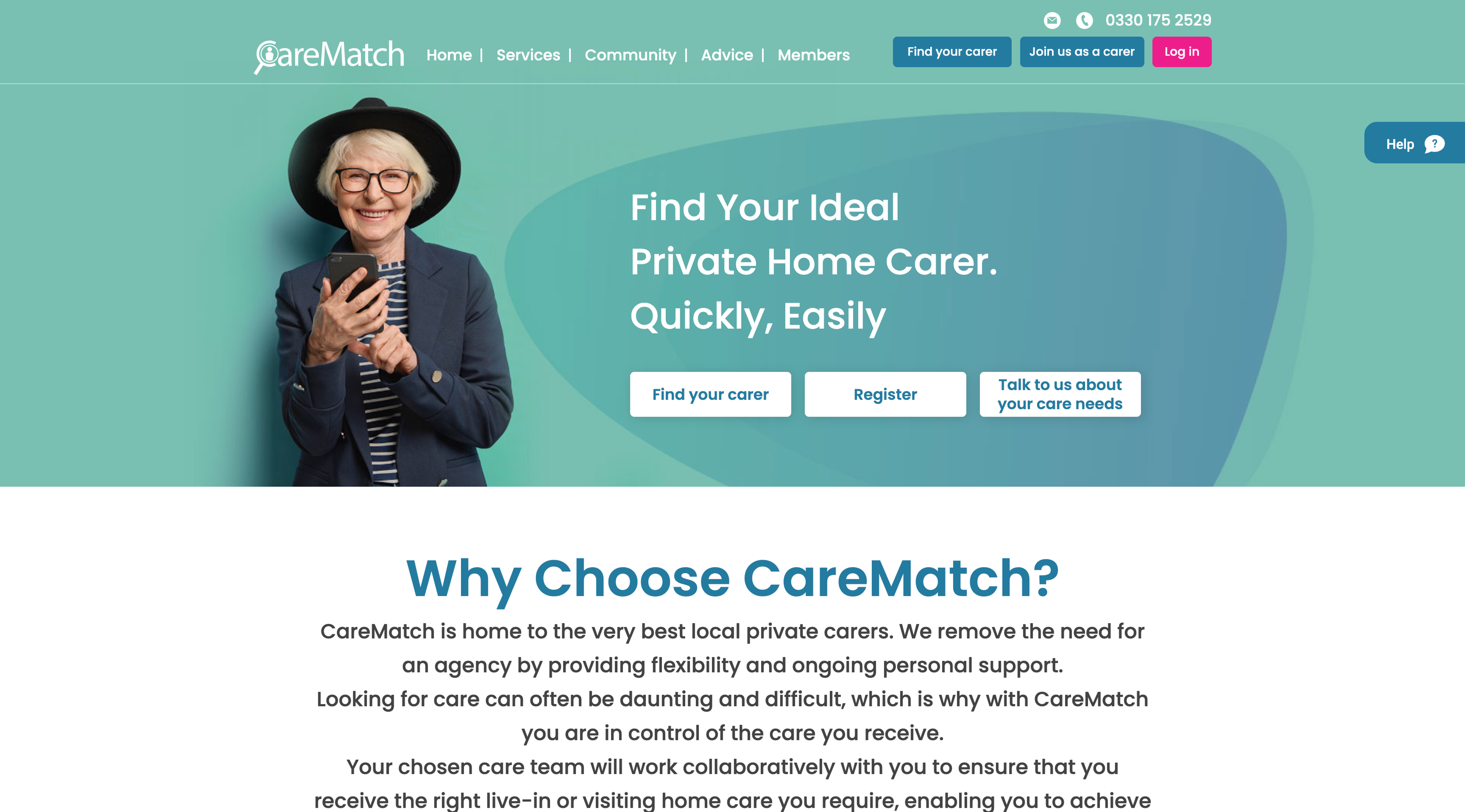
CareMatch is a UK home care platform that matches people who need care at home with local carers. The idea is simple: get carers matched with those who need them, and give both sides one place to organise the care.
The person arranging care sets out what is needed and when. Carers respond with the calls they can cover and the rates they charge. Once both sides agree, that becomes a contract and a rota. From there the carer uses the app to check in to each visit, work through the tasks, record the care and support provided and check out, and that drives the invoicing and the payments. Around each person receiving care there is a Care Hub, where family, carers and professionals stay in touch.
CareMatch supports both visiting care and live-in care. Today most of its work comes through the public sector, where the CareMatch team sets up the care on behalf of the people it looks after. The goal is to make the platform simple enough for anyone who needs care to use it directly.
Over 100 carers currently support more than 120 clients through the platform, and over 800 live-in and visiting carers are registered and ready to be matched with clients.
The challenge
The platform was live and matching carers who provided real care every day. The problem was the underlying architecture.
It had been built by a previous supplier and had been in production for about a year and a half. It worked, but it was not architected in a way CareMatch could easily build the next version on. Everything ran as one large application on a single server, with most of the business logic buried in the database. Performance started to suffer as the business grew, and the carer app could be slow to sync.
That showed up in daily operations. Schedules, rotas and contracts were where most of the problems were: duplicate calls, incorrect rates, the occasional schedule or medication entry going missing. Not all the time, but often enough to be a real nuisance for carers and for the CareMatch team. Setting up a care schedule was also too complicated for anyone outside that team to do.
There was very little documentation, the servers were still hosted by the previous supplier, and over time the code in production had drifted away from what was in the repository.
“We are a small company with a limited technology budget. So I did not need a big team. I needed people who could take the platform over safely, keep it running for the carers and clients who depend on it, fix what mattered most, and help me work out the right way to rebuild it.”
Why CodeLions
CareMatch and CodeLions were introduced through a founders’ network they both belong to.
“I ran a digital agency myself for more than twenty years, so I know this relationship from the supplier’s side and I know what a handover from another supplier can look like. What I noticed first was how structured the takeover was.”
Before touching anything, the team came with a clear checklist of everything it needed from the previous supplier: servers, accesses, deployments, mobile store accounts, code and backlog. Then it worked through the list step by step.
“In the very first product walkthrough they stopped me and said, honestly, that the scheduling flow was overwhelming and asked how a new user was supposed to cope with it. That was exactly the right question. It told me they were thinking about the product, not just about the code.”
The engagement was shaped around a reasonable monthly budget, with the right people involved for the hours CareMatch could afford, and it has stayed flexible as the situation changed.
“Although I was cautious at first and had already considered other options, as we started working together I realised that CodeLions were a great fit for CareMatch and my confidence in them has grown.”
How the team works
“It feels more personal than a customer and supplier relationship. Everyone on the team, the people we started with and the people who joined later, have been easy to work with.”
The process is kept light, because the size of the project does not justify daily stand-ups and heavy reporting: a weekly catch-up, a shared Slack channel, Jira for the work and Confluence for the documentation. Every month Tim gets a development report and a breakdown of the hours, so he always knows where the budget went.
The team is direct. Vitalii and Yurii do not assume that the way CareMatch does things today is the right way. They question it, and then both sides work towards an agreement. That is how the specification for version 2 was written: scoped together, within the hours CareMatch already had, so it could make an informed decision about the rebuild before committing to it.
The team listens as well. When Tim asked for more proactive communication, so he was not left wondering whether something was stuck or done, the team changed how it reports progress and blockers, and it has worked since.
“They are responsive. When the platform has a problem and I ask for help, including at the weekend, they help.”
Volo and Vitalii visited the CareMatch team in Salisbury in April 2026, and even a change of project manager on the CodeLions side went smoothly.
What changed in the platform
The current platform is under control, the billing is right, and version 2 has started.
The takeover
CodeLions took the platform over from the previous supplier, with no interruption to the service for carers and clients: knowledge transfer, accesses, environments, the mobile apps and the backlog. A new engineer has since got on top of a codebase that is hard to inherit.
Day-to-day stability
The team worked through the issues that affected carers and the CareMatch operations team most: duplicate calls and rotas, incorrect charge rates, login and onboarding problems, chat and Care Hub issues, and a series of Android app releases. Nearly 100 tasks and issues have been dealt with since the takeover, split evenly between tasks and bugs.
Billing and payments
CareMatch had to do more work on the current platform than it planned. The team delivered the new VAT calculation, including the exceptions for individuals, a new invoice and payment module, new PDF invoices, Stripe fees shown on the carer invoice and payment retries. It went live in October 2026.
“I was concerned that getting this live would be a struggle. It went live without any major issues.”
Version 2
The specification is written and the build has started on a modern stack, Java and React on Google Cloud. Registration, sign-in, verification and password recovery are built and demonstrated. Carer onboarding is next, as the first standalone module on the new infrastructure.
Outcomes
- Carers and clients keep a working service. The platform was taken over from a previous supplier with no interruption, and has been supported continuously since May 2025 by a small part-time team on a fixed monthly budget.
- When something urgent stops, the team typically responds within the hour, including outside working hours and at weekends.
- Invoices and payments are correct. The update to invoice generation and billing has made it clearer to carer members and more accurate.
- Nearly 100 tasks and issues dealt with since the takeover, split evenly between tasks and bugs.
- CareMatch knows what it is building next. Version 2 is scoped around the critical functions only, so every pound goes into getting to a live product as soon as possible, at a pace that suits the current budget.
- CareMatch is no longer tied to how the platform was first built. The new foundation lets it take advantage of new technologies, scale easily as the business grows and address usability issues found through operating the current platform.
What the client says
“Everyone on the CodeLions team has been easy and delightful to work with. It feels as if we work together on an almost personal level rather than as a pure customer and supplier. They don’t just assume that what we’ve done is the right way to do things. They question it, and then we work towards an agreement together. And when our platform has a problem and I ask for help at the weekend, they help. That responsiveness and willingness to go the extra mile has been really, really appreciated.”
What is next
The goal for 2027 is to complete version 2 and retire the old platform.
CareMatch will concentrate on the critical functions that need to be tested and live to take advantage of new technology and ways of working, and to take on board feedback from clients, carers, its internal team and its communities: getting carers onboarded, getting clients matched with them, and getting the hours and the payments flowing. Carer onboarding comes first, as a module that can be updated, improved and launched standalone, integrated with the current platform.
The new infrastructure will be more reliable and scalable, and cause less confusion for all users. It will take less of the operating budget than the servers CareMatch runs today, freeing up budget for development. CareMatch also sees a real role for AI in making the platform easier for clients, most of whom come to it knowing very little about how care works, and in taking routine work off its own team.
“We will go at the pace we can fund, and faster as the company grows. It is a good thing we are doing together, and I expect next year to be a lot more exciting.”
Other case studies
eSense: one dedicated engineer since 2021 → five years of monthly delivery with no serious production emergency
Read the story
Knowetic: from a no-code prototype to an MVP and production app → 150+ patients onboarded in six months
Read the story